
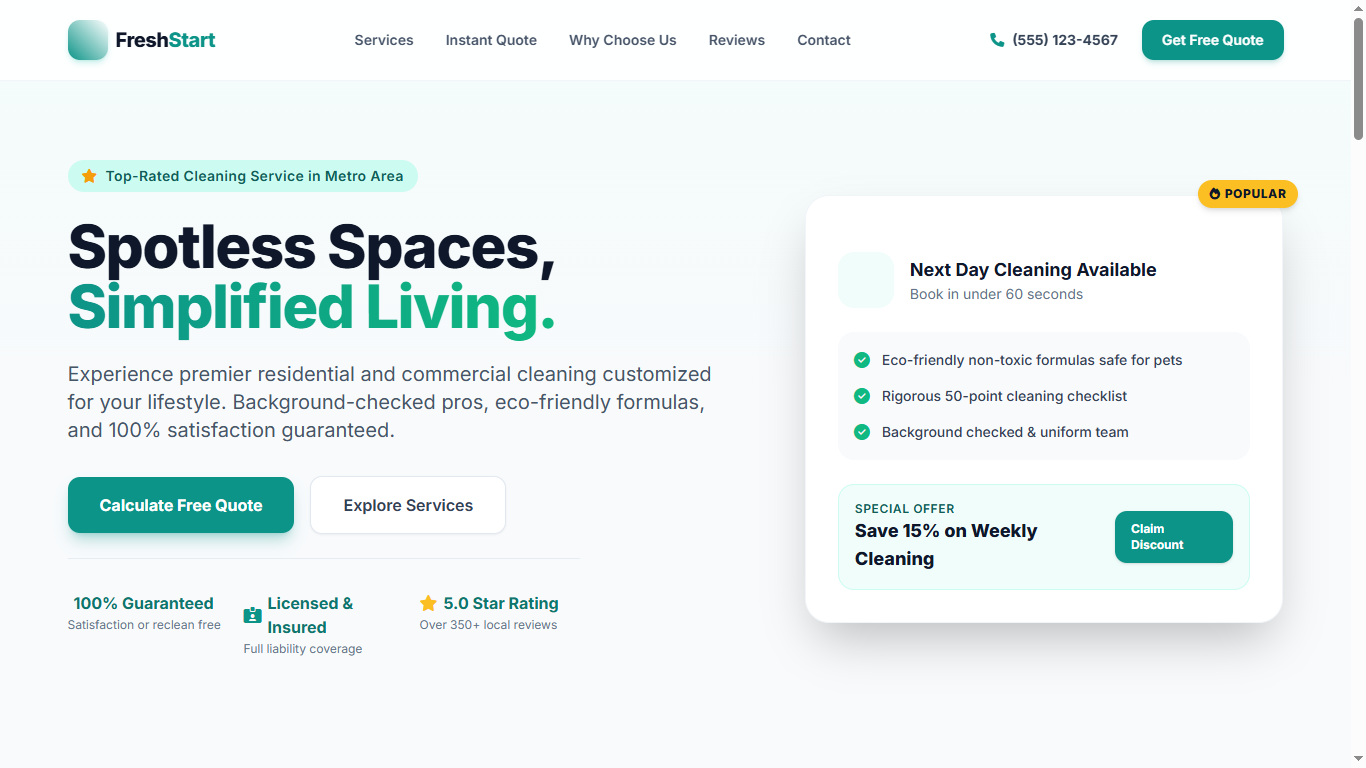
When building a website for a local service business, the ultimate goal is simple: turn visitors into paying customers as quickly and smoothly as possible.
For service brands—like the recent project built for FreshStart Cleaning—traditional multi-page website architectures can sometimes introduce unnecessary friction. Users are forced to click through separate pages for services, pricing, about sections, and contact forms, increasing drop-off rates.
Let’s look at an objective breakdown of why a single-page design architecture works best for local service websites, using the technical implementation from the FreshStart project as a blueprint.
1. Seamless User Journey & Zero Page Reloads
In a single-page architecture, all core information lives on a single, continuous vertical canvas, connected by smooth scrolling (scroll-smooth).
- Why it works: Users consume content naturally from top to bottom (Hero $\rightarrow$ Services $\rightarrow$ Calculator $\rightarrow$ Reviews $\rightarrow$ Contact) without waiting for new page loads.
- The technical advantage: By utilizing HTML anchor links paired with Tailwind CSS, visitors can jump straight to relevant sections instantly. For example, clicking “Book” on a service card triggers a helper function (
selectService()) that immediately shifts focus down to the interactive quote calculator.

2. Interactive Real-Time Conversion Tools (The Instant Quote Calculator)
One of the biggest hurdles in the cleaning and service industry is pricing transparency. Customers hate waiting 24 hours for a callback just to find out an estimate.
- Why it works: Integrating an interactive calculator directly into the single-page flow keeps user engagement high right at the point of decision.
- The technical execution: Built with dynamic JavaScript listeners, the calculator instantly recalculates pricing based on square footage, bedroom/bathroom counts, service tiers (Routine, Deep Clean, Move In/Out, Commercial), and frequency discounts. Users get immediate gratification, transparent pricing, and a clear path to lock in their quote without leaving the page.
3. Optimized Mobile Responsiveness & Thumb-Friendly Navigation
With over half of local search traffic originating from mobile devices, a single-page site offers a clean, app-like experience on smaller screens.
- Why it works: Mobile users prefer scrolling over navigating complex nested menus.
- The technical execution: Using a sticky glass-morphism header (
backdrop-filter: blur(12px)) with a collapsible mobile menu keeps critical actions—like the phone number and “Get Free Quote” CTA—pinned and accessible at all times. When a user taps a mobile menu link, it automatically closes the drawer and scrolls smoothly to the target section.
4. Higher Conversion Rates Through Reduced Friction
Traditional websites risk losing user interest across multiple page transitions. A single-page architecture controls the narrative tightly:
- The Hook (Hero): Instant trust signals, value propositions, and social proof (5.0 star rating, 350+ reviews).
- The Offer (Services): Clear, transparent pricing tiers starting at baseline rates.
- The Engagement (Calculator): Customizing parameters to fit their exact household or business size.
- The Conversion (Contact Form): A final, streamlined booking request form positioned at the bottom of the funnel.
Final Thoughts
Great web architecture isn’t just about how many pages you can create—it’s about how efficiently you can guide a user from curiosity to conversion. By combining a lightning-fast single-page layout with interactive tools like real-time estimators, service websites like FreshStart remove friction and deliver a frictionless digital experience.
Looking to structure your next web project for maximum performance and conversions? Let’s talk architecture. 🚀
Leave a Reply