
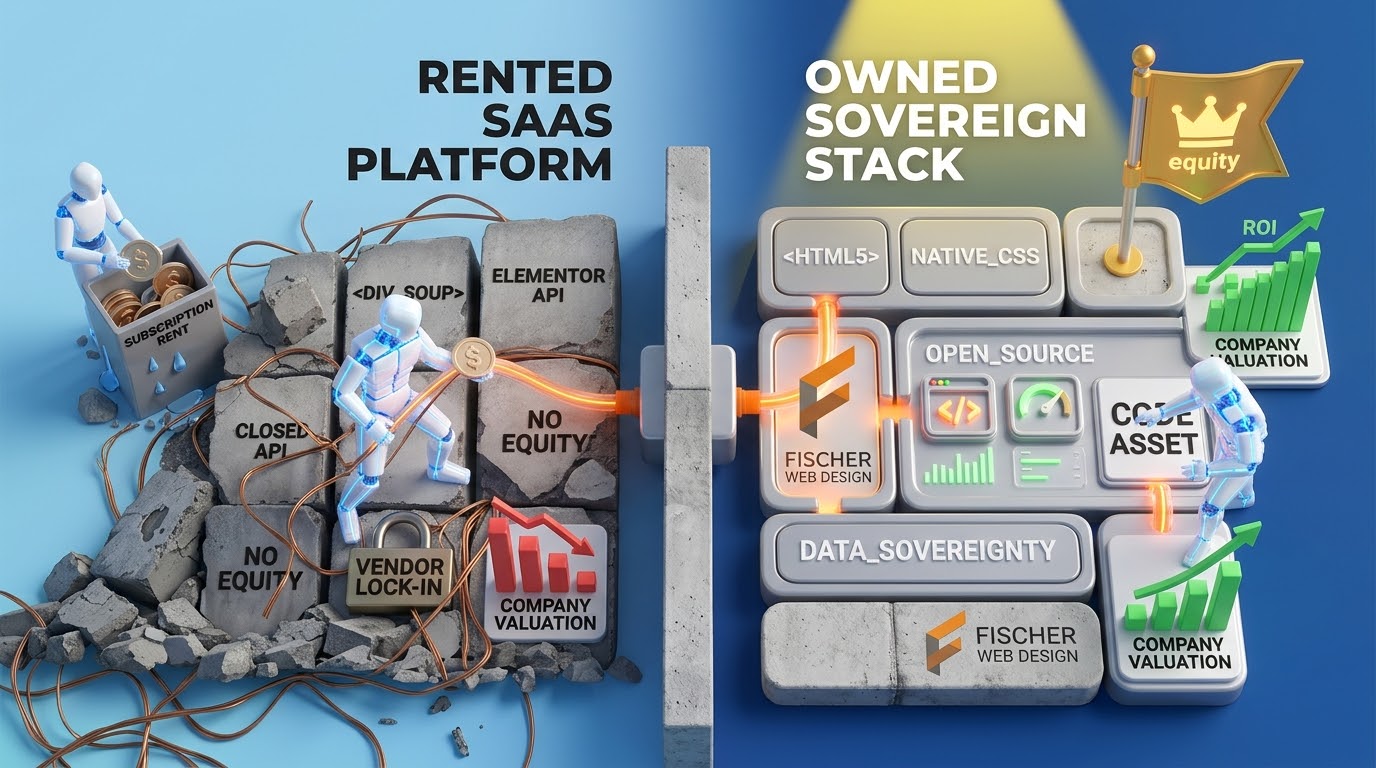
When a business owner purchases commercial real estate, the logic is straightforward: paying a monthly mortgage builds tangible equity, creates an appreciating balance sheet asset, and grants total control over the physical property. Nobody building a multi-million-dollar enterprise willingly chooses to pay non-equity rent on an empty lot that can be modified or re-priced at the landlord’s whim.
Yet, in the digital realm, thousands of profitable companies make this exact mistake every day.
They build their primary customer portal, lead generation engine, and brand authority on proprietary, closed-source SaaS platforms (Squarespace, Wix, Shopify, closed page builders). They pay monthly subscription fees for permission to display their own content, trapping their core digital infrastructure inside a rented garden.
When it comes time to scale, secure financing, or execute an exit strategy, these business owners discover a harsh truth: renting your digital real estate shrinks your company valuation.
To build lasting enterprise equity, forward-thinking leaders are shifting to a Sovereign Stack—an open-source, custom-coded web architecture that you own outright.
1. The Subscription Illusion vs. True Digital Equity
Proprietary web builders hook business owners with low upfront costs and drag-and-drop simplicity. It feels like an efficient shortcut—until you calculate the long-term total cost of ownership (TCO).
The “Rented” Platform Model
- Continuous Overhead: You pay monthly platform fees, premium plugin subscriptions, transaction surcharges, and tier upgrades indefinitely.
- Escalating Rent: The platform provider can raise monthly rates, alter terms of service, or sunset critical features without your input or consent.
- Zero Equity Accumulated: After five years and tens of thousands of dollars in platform and add-on fees, you own zero lines of the underlying source code. If you stop paying, your site vanishes.
The “Owned” Asset Model
- Capital Asset Creation: An upfront investment in clean, custom HTML5, native CSS, and an open-source CMS creates a permanent digital asset that sits on your company’s balance sheet.
- Predictable Operational Costs: You pay purely for standard cloud hosting and server infrastructure, drastically lowering your 3-to-5-year TCO.
- Total Freedom: You retain complete freedom to move, modify, export, or host your codebase on any server anywhere on earth.
2. Technical Due Diligence: How “Rented” Code Harms M&A Valuation
When institutional buyers, private equity firms, or business brokers evaluate a company during acquisition due diligence, they do not merely look at top-line revenue—they audit operational risk and asset ownership.
A business reliant on rented, proprietary web platforms presents major red flags during technical audits:
- Vendor Lock-In & Operational Vulnerability: If your entire sales funnel relies on a closed platform’s proprietary database and template engine, a buyer faces massive migration costs and technical risk to integrate your infrastructure into their existing portfolio.
- Restricted Scalability: Proprietary platforms enforce strict API rate limits, closed database structures, and rigid layout constraints that prevent custom enterprise integrations.
- Valuation Discounts: Acquiring entities routinely discount enterprise valuations when core customer acquisition assets are locked behind third-party subscription walls. Conversely, clean, portable, and fully owned custom code commands an asset premium.
3. Data Sovereignty and Strategic Independence
Beyond financial valuation, code ownership is a matter of data sovereignty and strategic agility.
When hosting your business on closed SaaS architectures, your customer interaction logs, conversion analytics, and content databases reside on shared third-party servers. If the platform experiences extended downtime, changes its content guidelines, or suffers an API breach, your operations are directly compromised.
In a custom-architected Sovereign Stack:
- You Own the Database: Customer inquiries, transaction histories, and user analytics live in isolated databases under your direct control.
- Uncompromising Speed & Optimization: Because you own the codebase, your web architect can optimize server response times (TTFB), strip out unneeded bloat, and guarantee sub-second page loads that maximize Core Web Vitals.
- AI & Search Dominance: You have complete freedom to inject custom JSON-LD schema, semantic HTML structures, and custom API endpoints to ensure your site is read and cited by AI crawlers (SearchGPT, Gemini, Perplexity) without platform-imposed code restrictions.
4. Engineering the Sovereign Asset
At Fischer Web Design, we build custom digital real estate engineered for longevity, extreme speed, and total code ownership.
We replace slow, bloated drag-and-drop builders with hand-crafted, modular theme architecture built directly on open-source standards. There are no monthly visual builder leases, no proprietary locks, and no artificial scaling ceilings.
You receive a high-speed, high-converting digital engine that belongs entirely to your business—protecting your balance sheet and elevating your enterprise value.
The Bottom Line
A website shouldn’t be an unending operational expense. It should be an appreciating digital asset that builds authority, drives high-intent leads, and strengthens your company’s net worth.
Stop paying rent on your digital foundation. Invest in custom architecture that you own forever.
Ready to Build Real Digital Equity?
At Fischer Web Design, we craft custom, high-performance web architecture built for sub-second page loads, maximum lead conversion, and total code ownership.
Call us directly at (810) 247-6340 or email fischerwebdev@gmail.com to audit your current web infrastructure and transition to a fully owned Sovereign Stack.
Leave a Reply