
Across cities and townships—from small Midwestern communities to county seats—the digital front door to local government is broken.
When a resident opens a municipal website, they aren’t looking to be entertained. They are trying to complete essential civic tasks: pay a water bill, check trash pickup schedules, submit a building permit application, review local zoning regulations, or read county commission meeting minutes.
Yet, most local government websites subject citizens to:
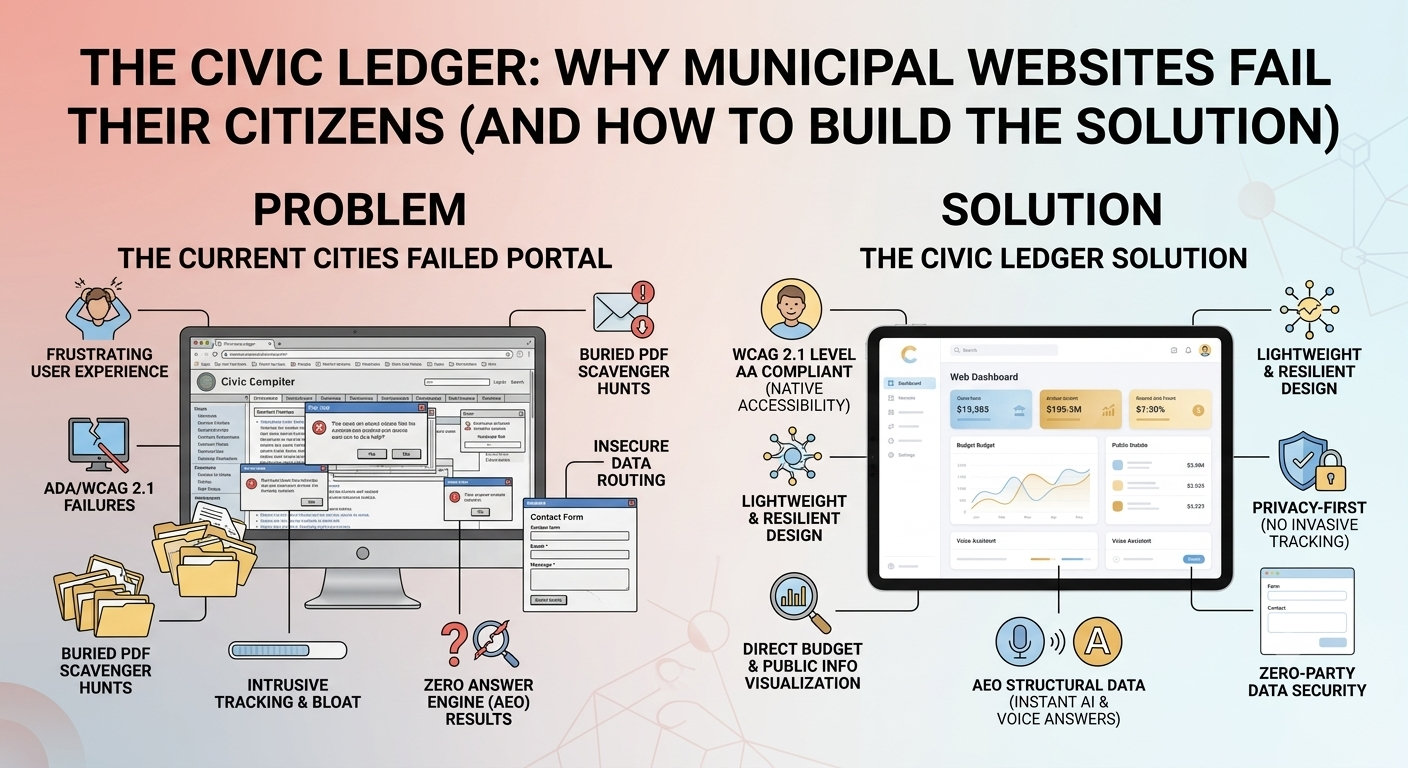
- Buried PDF Scavenger Hunts: Vital forms locked inside scanned PDFs that fail screen readers and mobile devices.
- Intrusive Tracking & Third-Party Bloat: Unnecessary third-party tracking scripts, bloated ad-network cookies, and sluggish CMS setups.
- ADA & Section 508 Accessibility Failures: Inaccessible navigation, poor color contrast, and lack of keyboard navigation that exclude residents with disabilities.
- Search Black Holes: Cluttered search engines that fail to deliver direct answers to basic queries like “When is leaf pickup in my district?”
This isn’t just a design flaw—it is a breach of public trust. When municipal infrastructure fails online, civic participation drops, administrative phone lines clog up, and local governments face legal liabilities under federal accessibility standards.
Here is why municipal websites fail, and how we build The Civic Ledger—a modern, privacy-first, hardened digital infrastructure for local governance.
The 4 Root Causes of Municipal Website Failure
1. Vendor Lock-In & Template Bloat
Many municipalities contract with legacy government CMS providers that offer bloated, one-size-fits-all templates. These platforms pack in heavy, unneeded plugins and proprietary codebases that slow load times to a crawl on mobile connections, making them fragile and expensive to maintain.
2. The PDF Trap
Instead of converting municipal codes, applications, and agendas into accessible HTML, legacy portals dump raw scanned PDFs onto pages. For residents on mobile devices or those using screen readers (Assistive Technology), these documents are virtually unreadable and impossible for modern search tools to index properly.
3. Lack of Zero-Party Data & Privacy Controls
Citizens should never be tracked when accessing public services. Many municipal portals inadvertently run third-party tracking cookies, analytics trackers, and external font scripts that leak resident IP addresses and digital activity to third-party ad networks.
4. Zero Answer Engine Optimization (AEO)
Modern citizens use voice assistants, mobile search, and AI answer engines (like Gemini, ChatGPT, or Siri) to find immediate answers to city questions. When local portals lack structured data and clear taxonomy, answer engines hallucinate or fail, forcing residents to call city hall for basic questions.
The Solution: Architectural Framework for The Civic Ledger
To restore digital integrity to local governance, municipal web architecture must be rebuilt from the ground up on three core pillars: Resilient Design, Transparent Governance, and Privacy-First Operations.
+-----------------------------------------------------------------------+| THE CIVIC LEDGER |+-----------------------------------+-----------------------------------+| 1. ACCESSIBLE & RESILIENT | 2. TRANSPARENT GOVERNANCE || - WCAG 2.1 Level AA Compliance | - Open Data Architecture || - Lightweight HTML5/CSS | - Live Integrity & Audit Logs || - Mobile-First Performance | - Direct Budget Visualization |+-----------------------------------+-----------------------------------+| 3. PRIVACY-FIRST & SECURE | 4. AEO-READY STRUCTURAL DATA || - No-Cookie Tracking Guarantee | - Schema.org Municipal Markup || - Zero-Party Data Routing | - Instant AI & Voice Answers |+-----------------------------------+-----------------------------------+
Pillar 1: Accessible & Resilient Design (WCAG 2.1 Level AA)
Public services must be accessible to every resident, regardless of physical ability or device constraint.
- Native Accessibility: Native HTML5 semantics, explicit ARIA attributes, high-contrast typography, and full keyboard navigation ensure true Section 508 and WCAG 2.1 Level AA compliance—without relying on band-aid overlay widgets that fail legal scrutinies.
- Lightweight Speed: Minimized CSS and lean markup allow pages to load instantly, even over rural 3G/4G connections.
Pillar 2: Transparent Governance & Live Integrity Logs
Trust in local government requires complete operational transparency. The Civic Ledger replaces opaque navigation with direct, interactive verification tools:
- Budget & Expenditure Visualizations: Clean, lightweight SVG and table breakdowns showing exactly where tax dollars are allocated.
- Public Document Sync: Meeting minutes, ordinances, and public notices rendered directly in clean, indexable web pages alongside downloadable text formats.
- System Integrity & Audit Logs: Public transparency seals detailing recent security audits, system uptime, and compliance verifications.
Pillar 3: Privacy-First & Zero-Party Data Security
Local government portals should set the standard for digital privacy.
- The No-Cookie Guarantee: Elimination of invasive tracking cookies and third-party ad-network scripts.
- Secure Resident Portals: Direct, encrypted routing for utility payments, permit requests, and citizen inquiries that process data without selling or storing sensitive resident information in vulnerable databases.
Pillar 4: Answer Engine Optimization (AEO) for Public Info
When a resident asks, “What day is recycling collected in District 2?”, they should receive an immediate, accurate response—whether searching on the city website or asking a voice assistant.
By embedding structured Schema.org/GovernmentOrganization and Schema.org/GovernmentService metadata, civic websites become directly readable by search engines and modern AI tools, cutting down phone inquiries to city hall by enabling instant, automated answers.
A Call to Action for Local Leaders
A municipal website is more than an online brochure—it is essential public infrastructure. Just as local leaders invest in roads, water systems, and emergency services, investing in a secure, accessible, high-performance web foundation protects resident privacy, ensures compliance, and strengthens community trust.
At Fischer Web Designs, we apply our Web of Trust philosophy to engineering civic portals that are lightning-fast, fully accessible, and built to stand the test of time.
Ready to Modernize Your Community’s Digital Infrastructure?
Explore our custom civic builds and municipal site evaluations at Fischer Web Designs. Let’s build a digital gateway your citizens can trust.
Leave a Reply