
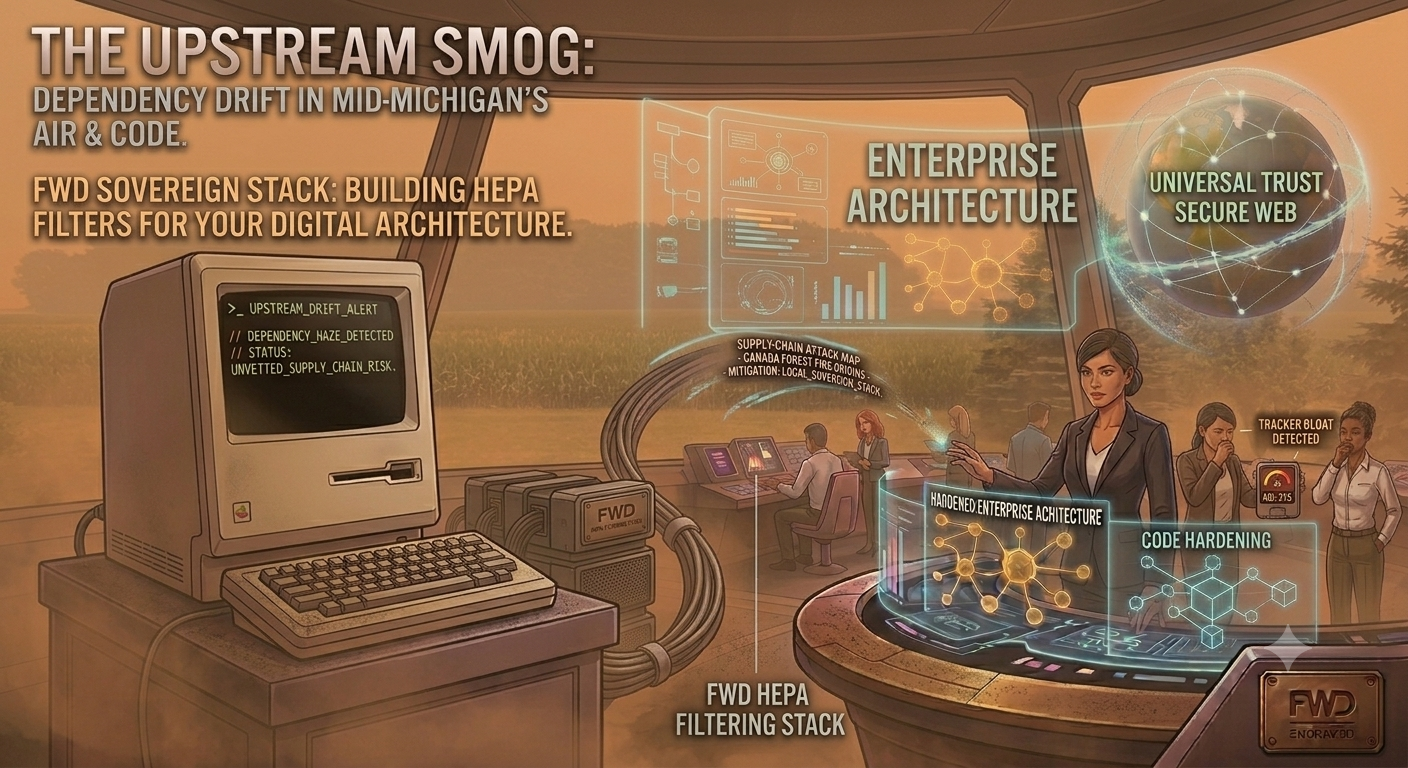
I am sitting at my desk in Chesaning, Michigan, looking out the window on a heavy Thursday in mid-July.
Normally, July in Michigan is crisp blue skies and bright summer sun. Today, the horizon is wrapped in a thick, toxic, orange-gray shroud. The Air Quality Index (AQI) has quietly ticked past 200. The air smells faintly of burnt pine, and local news stations are warning residents to stay indoors, seal their windows, and turn on their HEPA filters.
The source of this heavy smog? Forest fires burning hundreds of miles away in the Canadian wilderness.
It is a stark, uncomfortable reminder of our physical interconnectedness: a spark in a distant forest can choke out a small town in Mid-Michigan half a week later.
As a web architect, I can’t help but see a profound technical parallel here. In the digital world, we deal with our own version of this invisible, drifting pollution.
We call it Upstream Dependency Drift. And just like physical wildfire smoke, it is quietly choking the performance, security, and usability of your digital infrastructure.
The Illusion of the “Clean” Build
When most businesses or municipalities buy a website or a client portal, they assume they are purchasing a self-contained, isolated structure. They look at their shiny new homepage and think, “This is ours. We own this. It runs on our server.”
But under the hood of the average, modern website lies a fragile web of outsourced code.
To build things quickly, modern developers rarely write code from scratch. Instead, they stack libraries, frameworks, and packages on top of one another. Your site might use a third-party script to render a button, another to process a form, and a dozen more to track analytics, display fonts, or handle styling.
These are your upstream dependencies.
On a clear day, the system works. But your code is constantly reaching out across the internet to servers, repositories, and third-party clouds that you do not own, do not control, and have never audited.
When the Upstream Catches Fire
What happens when one of those distant, upstream libraries suffers a breach, a deprecation, or a server crash?
Just like the Canadian fires, the digital smoke drifts downstream directly into your user’s lap:
- The Supply-Chain Security Breach: In modern cyber warfare, hackers rarely attack high-security enterprise databases head-on. Instead, they look upstream. They find a minor, open-source code package used by millions of websites, hijack it, and inject a malicious script. Suddenly, your local municipal portal is serving malware to your residents, even though your server was never directly hacked.
- The Performance Smog: When you load a website that relies on thirty different third-party scripts, your browser has to make thirty different requests to servers all over the globe. If one of those upstream servers experiences a micro-delay, your entire page freeze-frames. Your users are left staring at a blank screen, waiting for a tracker in Silicon Valley to respond.
- The Silent Code Rot: Web packages update constantly. If an upstream developer deprecates a single line of JavaScript in a minor utility library, your custom login portal can instantly break overnight with zero warning, leaving you scrambling to find the “fire” in a haystack of thousands of lines of code.
How to Clear the Digital Air: The “Sovereign” Approach
How do you survive an AQI 200+ day in Michigan? You close your windows, isolate your indoor air, and rely on localized filtration systems.
How do we protect your business or municipality from digital smog? We implement Digital Sovereignty through a strict Web of Trust blueprint:
- Ruthless Dependency Budgets: We don’t pull in a massive, bloated library just to perform a simple task. At Fischer Web Designs, if we can write a clean, native, 10-line block of semantic HTML5 and vanilla CSS to achieve an effect, we write it ourselves. We keep your code clean, lightweight, and self-contained.
- Local-First Caching: We self-host our fonts, icons, and essential scripts. Your website should not have to query Google, Adobe, or an unvetted public CDN just to display a basic paragraph of text. By keeping files local to your server, we eliminate upstream vulnerability and slash load times.
- Hardened Isolation & Auditing: When we must use third-party libraries (such as core WordPress elements), we lock them down behind cryptographic hashes, strict content security policies (CSP), and automated dependency audits. If an upstream file changes without our signature, the gateway locks down automatically.
Let’s Build a Self-Contained Fortress
It’s easy to ignore the smog when the skies are blue. But relying on a fragile, highly-dependent codebase is a gamble. Sooner or later, someone else’s fire will blow into your backyard.
Don’t let upstream slop ruin your downstream reputation. Whether you are managing utility portals for local residents or hosting proprietary business data, it’s time to close the digital windows, clean the pipes, and secure your structural sovereignty.
Stay safe, stay indoors, and let’s build a web that actually stands on its own soil.
Leave a Reply