
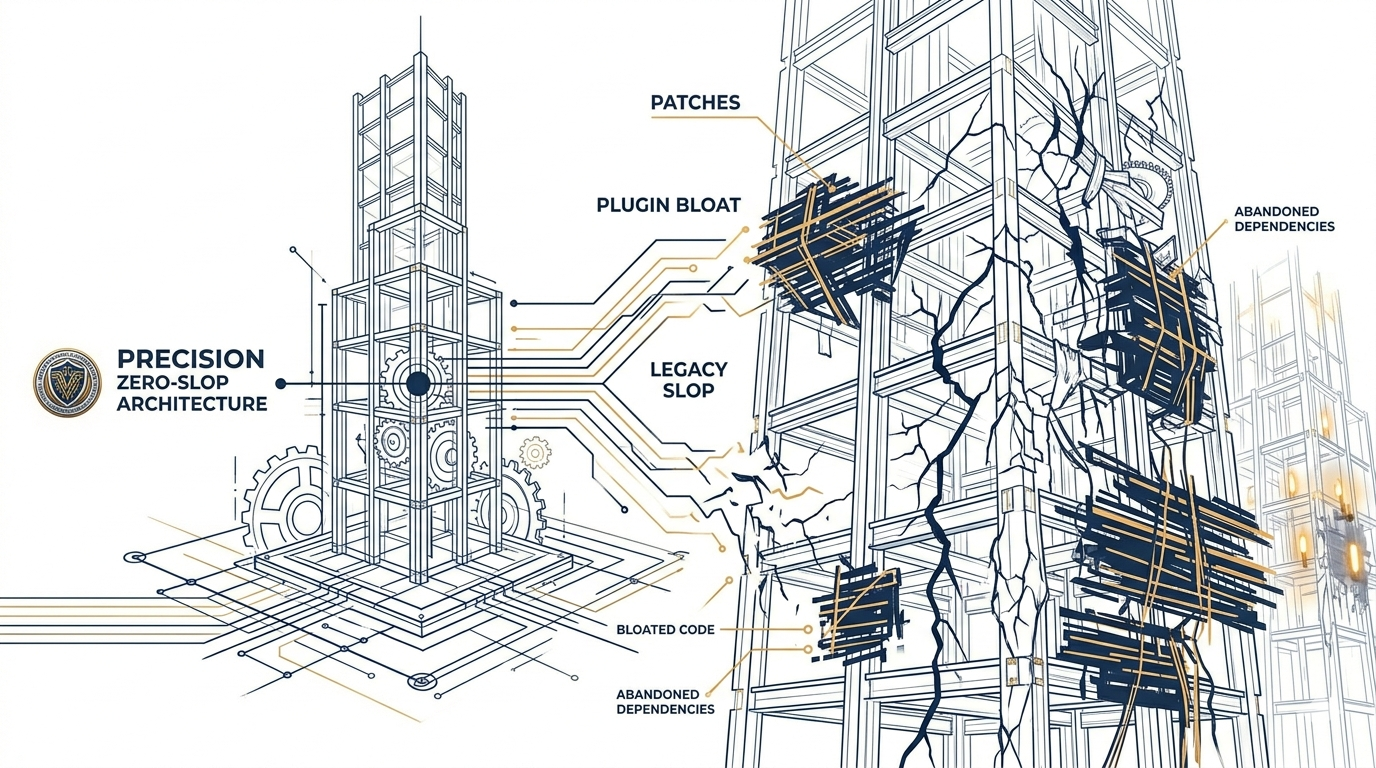
In physical architecture, everyone understands the danger of cutting corners. If a builder uses cheap drywall where structural concrete is required, or skips the foundational leveling to save a few thousand dollars, the building will eventually crack, leak, or collapse.
Yet, in the digital world, businesses routinely purchase structural infrastructure off the clearance rack. They hire developers who trade in “Slop”—bloated code, unmanaged plugin stacks, and heavy, rigid page builders.
Let’s look at the true, hidden architectural costs of cheap web development, and why a “Zero-Slop” philosophy is the only way to safeguard your business efficiency.
1. The Ghost in the Machine: Plugin Over-Dependency
The hallmark of a cheap development process is the “there’s a plugin for that” mentality. Need a slider? Install a plugin. Need to move a button? Install a plugin. Need basic analytics? Install another one.
- The Reality: Every plugin you add is an unvetted third-party dependency. They turn your website into a digital Frankenstein. When three different plugins update at different times, they inevitably conflict, breaking your checkout flows, form submissions, or database connections.
- The Cost: Hours of downtime, missed client leads, and emergency developer fees to untangle the mess. An architect doesn’t glue random parts to a house; they engineer the core to handle the load natively.
2. Performance Inflation: The Bloat Tax
Cheap websites look fine on a high-end desktop computer over a fiber-optic corporate network. But try loading that same site on a three-year-old mobile device using a fluctuating 4G connection at a crowded airport.
When code is sloppy, the browser has to work exponentially harder to parse the page.
- The Reality: Heavy visual builders inject massive amounts of unnecessary wrappers (
<div>tags inside<div>tags) just to render a single line of text. This is “slop code.” It forces the user’s phone to download megabytes of layout data before they can even read your phone number. - The Cost: Conversion destruction. Google’s data shows that if a page takes longer than 3 seconds to load, over half of your visitors abandon it. Cheap development saves you money upfront but taxes every single interaction your customers attempt to make.
3. The Security Vacuum
A poorly architected website isn’t just slow—it’s vulnerable. Because cheap developers rely on third-party frameworks and abandoned plugins to do the heavy lifting, they inadvertently open backdoors into your system.
- The Reality: Automated bots constantly crawl the web looking for known vulnerabilities in common, unpatched web elements. If your site’s foundation is built on a house of cards, it’s only a matter of time before it’s injected with malware, or worse, your customer data is compromised.
- The Cost: Complete loss of consumer trust, legal non-compliance penalties, and the catastrophic expense of post-breach digital cleanup.
The “Zero-Slop” Alternative: True Digital Architecture
When I build on a platform like WordPress, I treat it as a raw engineering material. I reject pre-packaged bloat.
A custom-architected website means:
- Clean Semantic Code: HTML and CSS written with precision, ensuring that search engines and browsers can read your site instantly.
- Minimalist Logic: Building custom functionality directly into a lean, lightweight theme layout rather than stacking volatile plugins.
- Longevity: A system designed to scale smoothly as your business grows, meaning you won’t have to pay for a total rewrite two years from now.
The Verdict:
Cheap development isn’t an investment; it’s high-interest technical debt. Stop paying the “slop tax” on your company’s efficiency, speed, and security. It’s time to build a foundation that lasts.
Leave a Reply